Friday, March 26, 2010

Anatomy of Spinal Cord

Dr Arun L Naik Spine Surgeon Bangalore India

Spinal column is a stack of many bones in your back. It starts from the base of the skull bone and ends in the lower most part of seating bone called the coccyx. It is highly mobile in its upper and lower ends that is cervical and lumbar ends. Each of these bones are separated from one another by intervertebral discs or simply 'discs' which act as shock absorbers for your back. The spinal column is made up of cervical, thoracic, lumbar, sacral and coccyx bones. The spinal cord runs in the centre of the bone called 'spinal canal'. Spinal cord begins at the base of skull and ends near L1 vertebra.

Spinal cord has many roots attached to it. These nerve roots are responsible for all the movements and sensations the body deals with. These roots exit the spinal bones through 'spinal foramina', small cavity in the sides.
Vertebre
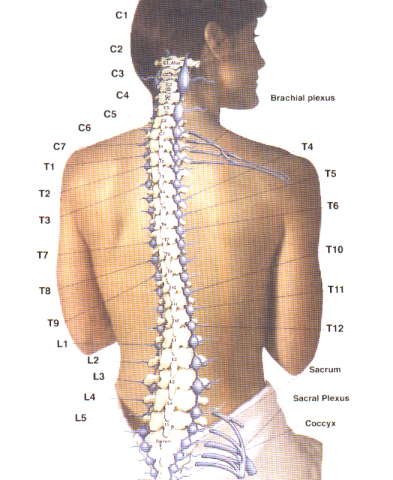
vertebre.jpg
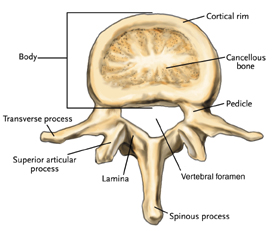
The vertebral body is a thin ring of dense cortical bone. The vertebral body is shaped like an hourglass, thinner in the center with thicker ends. Outer cortical bone extends above and below the superior and inferior ends of the vertebrae to form rims. The superior and inferior endplates are contained within these rims of bone.
Pedicles
The pedicles are two short rounded processes that extend posteriorly from the lateral margin of the dorsal surface of the vertebral body. They are made of thick cortical bone.
Laminae
lamina.jpg
The laminae are two flattened plates of bone extending medially from the pedicles to form the posterior wall of the vertebral foramen. The Pars Interarticularis is a special region of the lamina between the superior and inferior articular processes. A fracture or congenital anomaly of the pars may result in a spondylolisthesis.
Intervertebral Discs (IVD)
ivd.jpg
Intervertebral discs are found between each vertebra. The discs are flat, round structures about a quarter to three quarters of an inch thick with tough outer rings of tissue called the annulus fibrosis that contain a soft, white, jelly-like center called the nucleus pulposus. Flat, circular plates of cartilage connect to the vertebrae above and below each disc. Intervertebral discs separate the vertebrae, but they act as shock absorbers for the spine. They compress when weight is put on them and spring back when the weight is removed.

Intervertebral discs make up about one-third of the length of the spine and constitute the largest organ in the body without its own blood supply. The discs receive their blood supply through movement as they soak up nutrients. The discs expand while at rest allowing them to soak up nutrient rich fluid. When this process is inhibited through repetitive movement, injury or poor posture, the discs become thinner and more prone to injury. This may be a cause of the gradual degeneration of the structure and function of the disc over time.
Facet Joints
facetjoints.jpg
Joints between the bones in our spine are what allow us to bend backward and forward and twist and turn. The facet joints are a particular joint between each vertebral body that help with twisting motions and rotation of the spine. The face joints are part of the posterior elements of each vertebra. * Each vertebra has facet joints that connect it with the vertebrae above and the vertebrae below in the spinal column. The surfaces of the facet joints are covered with smooth cartilage that help these parts of the vertebral bodies glide smoothly on each other.
Ligamentum Flavum
The ligamentum flavum is a strong ligament that connects the laminae of the vertebrae. The term "flavum" is used to describe the yellow appearance of this ligament in its natural state. The ligamentum flavum serves to protect the neural elements and the spinal cord and stabilize the spine so that excessive motion between the vertebral bodies does not occur. It is the strongest of the spinal ligaments and often has a thinner middle section. Together with the laminae, it forms the posterior wall of the spinal canal.
Spinal Cord
spinalcord.jpg
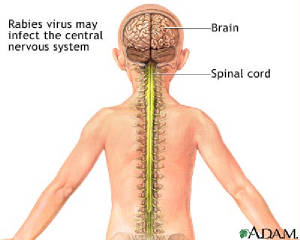
The spinal cord is part of the central nervous system of the human body. It is a vital pathway that conducts electrical signals from the brain to the rest of the body through individual nerve fibers. The spinal cord is a very delicate structure that is derived from the ectodermal neural groove, which eventually closes to form a tube during fetal development. From this neural tube, the entire central nervous system, our brain and spinal cord, eventually develops. Up to the third month of fetal life, the spinal cord is about the same length as the canal. After the third month of development, the growth of the canal outpaces that of the cord. In an adult the lower end of the spinal cord usually ends at approximately the first lumbar vertebra, where it divides into many individual nerve roots (L1).
Spinal Canal
The spinal canal is the anatomic casing for the spinal cord. The bones and ligaments of the spinal column are aligned in such a way to create a canal that provides protection and support for the spinal cord. Several different membranes enclose and nourish the spinal cord and surround the spinal cord itself. The outermost layer is called the "dura mater," which is a Latin term that means "hard mother," indicating that early anatomists had at least a rudimentary sense of humor. The dura is a very tough membrane that encloses the brain and spinal cord and prevents cerebrospinal fluid from leaking out from the central nervous system. The space between the dura and the spinal canal is called the "epidural space". This space is filled with tissue, vessels and large veins. The epidural space is important in the treatment of low-back pain, because it is into this space that medications such as anesthetics and steroids are injected in order to alleviate pain and inflammation of the nerve roots.

Dr Arun L Naik is a spine surgeon practicing in Bangalore India for 14 years.

Who is a Neurosurgeon?


The Neurosurgeon treats the diseases of brain, spinal cord and nerves and their subsystems. This is relatively newer medical superspeciality which has evolved in the last fifty years or so as a separate entity. Diseases of the brain and its subsystem pose a very difficult clinical setting to deal with. Arguably, neurosurgery is the most difficult and challenging of all medical specialties. A dream destination for many budding medical students, neurosurgery is one of the glamourous medical branch.
A neurosugeon undergoes a very vigorous training spanning almost 12 years to become one. This is one of the most difficult subjects to succeed as the examination process is laborius and passing rate very low. Once getting MCh degree, there are ample opportunities for a budding neurosurgeon in India. Most of the neurosurgeons prefer to be in larger cities leaving smaller cities without a basic facility of neurosurgery. As there are only a few medical schools having neurosurgery teaching facilities, there is always a great demand for neurosurgeons world over.
As I mentioned earlier, surgery of the brain is very complex, and margin of error too thin. It requires a great skill and practice to operate on the body's greatest organ. It is very essential for any fresh neurosurgeon to spend sometime in a busy neurosurgical setting before honing their surgical skills.
With this background check, let us learn what are the diseases neurosurgeons treat.
- Brain injury due to trauma
- Brain tumors
- Stroke
- Bleeding in the brain
- Birth defects of brain and spine
- Slipped disc, spondylosis
- Spine injury

Dr Arun L Naik is a neurosurgeon in Bangalore India

You have been entrusted with the care and feeding of the most extraordinary and complex creation in the universe. Home to your mind and personality, your brain houses your cherished memories and future hopes. It orchestrates the symphony of consciousness that gives you purpose and passion, motion and emotion.

But what do you really know about it?
The brain is the most complex part of the human body. This three-pound organ is the seat of intelligence, interpreter of the senses, initiator of body movement, and controller of behavior. Lying in its bony shell and washed by protective fluid, the brain is the source of all the qualities that define our humanity. The brain is the crown jewel of the human body.

For centuries, scientists and philosophers have been fascinated by the brain, but until recently they viewed the brain as nearly incomprehensible. Now, however, the brain is beginning to relinquish its secrets. Scientists have learned more about the brain in the last 10 years than in all previous centuries because of the accelerating pace of research in neurological and behavioral science and the development of new research techniques.

Together, the brain and spinal cord make up the central nervous system. They are covered by three layers of membranes called meninges and bathed in protective cerebrospinal fluid, which acts as a "shock absorber" to help prevent injury.

The largest part of the brain is comprised of the cerebrum, which is split into right and left hemispheres. The cerebrum controls voluntary actions, thought, speech, and memory. Most mammals have a relatively small cerebrum, but in humans it makes up most of the brain. This allows us to perform much more complicated actions than other species can.

The cortex, or "gray matter," is the outer layer of the cerebrum, made up mostly of the cell bodies of neurons, or nerve cells. Most of the brain's work of processing information is done in the folds of gray matter. This is where the blueprints are stored that contain the vital information of our intelligence, memory, personality, emotion, speech, and ability to move and function in familiar and complex ways. Nerve fibers found in the cortex's underlying white matter carry messages into the brain for additional processing. These messages are then relayed to other parts of the nervous system, which carry them out.

The midbrain, located deeper within the brain's structure, acts as a cellular switchboard, keeping the different areas of the brain communicating with one another. This is necessary for the brain to carry out its most complicated functions, because its simultaneous commands require proper routing and coordination.

The central structure of the brain contains the thalamus, hypothalamus, and pituitary gland. The thalamus carries messages from the sensory organs to the brain. The hypothalamus regulates automatic functions such as changes in pulse rate, thirst, appetite, and sexual and sleep patterns. It also regulates the pituitary gland's production of multiple hormones that play roles in growth, metabolism, fluid and mineral balance, sexual function, and the body's response to stress. Four ventricles (cavities within the brain) contain cerebrospinal fluid, which protects the brain's delicate structure, nourishes brain tissue, and carries away waste materials.

The back of the brain is divided into three parts. The cerebellum (Latin for "little brain") is located below the cerebral hemispheres and controls our ability to make coordinated and balanced motor movements. The medulla oblongata, which connects the brain to the very top of the spinal cord, controls many of the involuntary actions of our bodies, such as the regulation of heartbeat, breathing, and digestion. The pons is a specialized band of nerve fibers that links the midbrain with the medulla oblongata and acts as a high-functioning switchboard.

The spinal cord is a long shaft of tissue made up of neurons and supporting cells that is covered by meningeal membranes. Extending from the bottom of the medulla oblongata, the spinal cord is surrounded and protected by a stacked set of ring-shaped bones called the vertebrae, which together make up the spinal column. The spinal column is classified by region: cervical (neck), thoracic (rib cage/upper back), lumbar (mid-/lower back) and sacral (tailbone). Nerves branch off from the spinal cord, passing through the bony vertebrae and extending out to the organs and body parts to which they are specifically "wired." In the spaces between the vertebrae is a rubbery material called cartilage. These cartilage cushions, called spinal disks, allow flexible movement between the vertebrae so that our backs can bend and absorb shock when we run, jump, and otherwise exert ourselves.

Monday, March 22, 2010

About Me


I am a consultant neurosurgeon based at the garden city, bangalore in India. Here are my professional details

I had my medical graduation (MBBS) from Karnataka Medical College, Hubli.

I had my specialty training in surgery (MS) from All India Institute of Medical Sciences (AIIMS), New Delhi.

I was trained in Neurosurgery (MCh) at All India Institute of Medical Sciences (AIIMS), New Delhi.

I am a Senior Consultant Neurosurgeon working at BGS Global Hospitals in Bangalore. I have worked at All India Institute of Medical Sciences, New Delhi, Sri Sathya Sai Institute of Higher Medical Sciences, Bangalore and Hosmat Hospitals before.

I have performed all types of neurosurgical procedures including neurovascular surgery, Brain tumors, AVM surgery, skull base surgery, spine surgery, pediatric neurosurgery to name a few. I do have special interest in neuronavigation surgery and i have done hundreds of such complex surgeries. Also, I have trained many surgeons from India and abroad in neuronavigation surgery.

I have been invited for many national and international conferences and workshops to share my expertise specially in the field of brain tumor surgery.
Blog dedicated for my patients. The basics of neurosurgery, brain, nervous system and its diseases are highlited. You can browse through the details of treatment, complications and results of various neurosurgical procedures. You can also find up-to-date info on the recent trends in managing patients with neurological diseases. Happy blogging....